有機半導體傳輸主要可以受控於兩個重要的參數根據Marcus-Hush Equation,此兩項參數分別為1. 分子間交互作用-Intermolecular coupling – 分子間交互作用力強,則可提升分子間載子之跳躍傳輸效果,進而提升有機半導體的傳輸能力。 2. 重組能-Reorganization energy – 重組能主要表達為載子由某一分子跳越至另一分子時,分子間達成平衡所需耗費的能量,意即重組能越大,則載子跳躍所需能量越大,故傳輸便更為困難。 此兩機制在半導體中具有相互消長與干擾的機制,因此在研究有機半導體,如何將兩項參數達成最大的傳輸效果,是目前學術界研究的重大課題。
【驗證參數】Davydov Splitting
————————————————
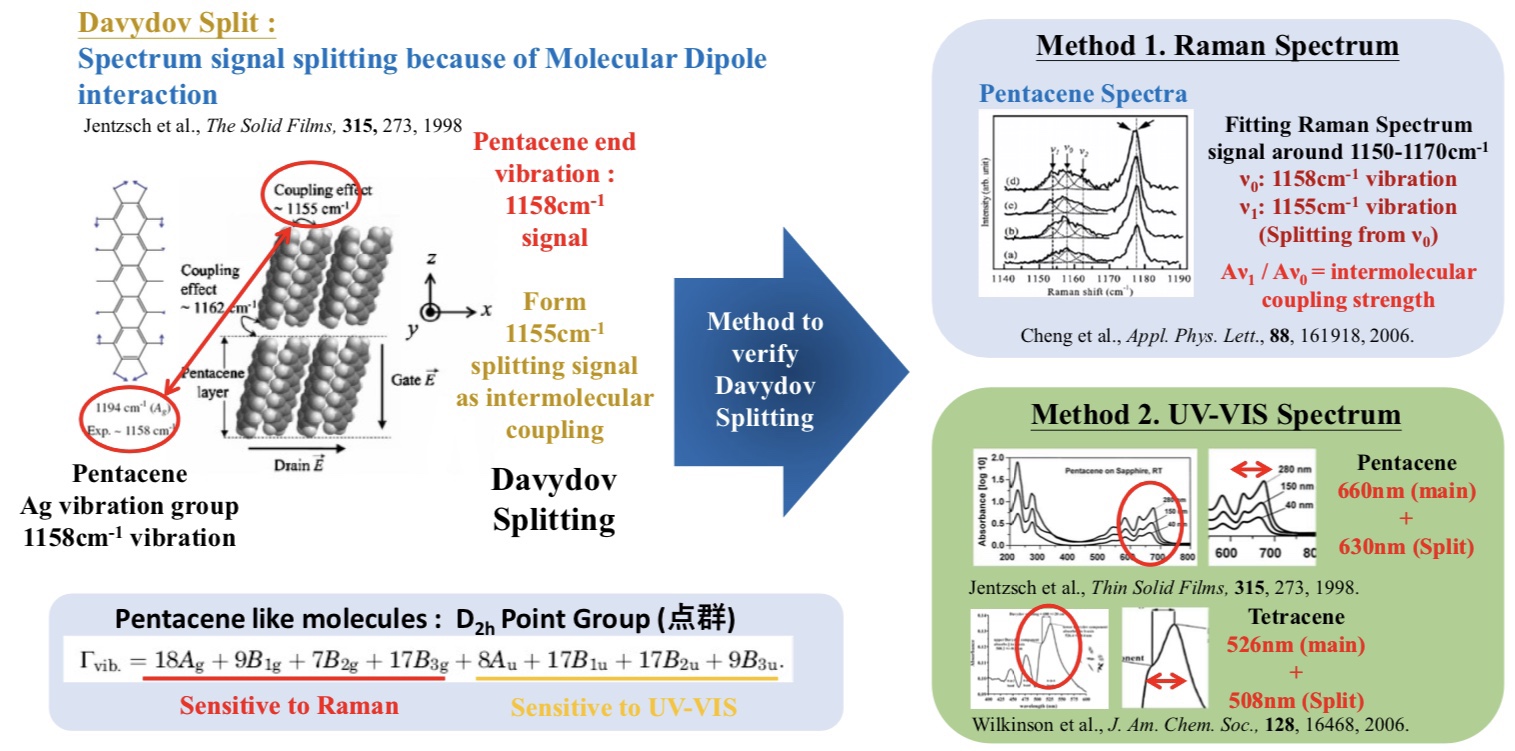
在探討有機半導體之傳輸特性,與無機半導體不同的地方是,有機分子的傳輸模式來自於分子間的交互作用,交互作用力強,則分子傳輸的效果越佳,便能提升有機薄膜電晶體之載子移動率。本研究主要整理文獻上用來驗證有機半導體分子交互作用的方法,並提出新的概念來了解更深入的有機半導體傳輸變化效果。 有機半導體分子間交互作用,根據A. S. Davydov的理論,可以在光譜上被量化,在光譜上有某些區塊會因為分子間交互作用而分裂,此項分裂便稱為Davydov Splitting,有關Davydov Splitting相關探討,可參閱以下文獻。 而利用Davydov Splitting光譜上之能量分裂,我們可以進而計算出分子間的耦合能量,得知分子間交互作用力的強弱。
【以拉曼光譜驗證五苯環Pentacene有機半導體傳輸】
目前學術界上建立此模型的學者為成功大學鄭弘隆教授,其利用拉曼光譜的光譜分裂,以Fitting的方式,來計算出電晶體上分子耦合的變化量,得知Pentacene分子間交互作用的強弱。鄭弘隆教授針對這樣的驗證方式提出了多篇關於有機薄膜電晶體在各項條件中的電性對應分子間耦合能變化量的研究。 1. 不同介電層對應之有機薄膜電晶體特性與其有機薄膜耦合能之分析 2. 不同Pentacene厚度之有機薄膜電晶體特性與耦合能之分析 3. 不同加壓時間對應之有機薄膜電晶體特性與耦合能分析
【以紫外光/可見光光譜驗證Pentacene有機半導體傳輸】
而本研究室主要提供了另外一項關於驗證分子間耦合能的另一個方法,便是利用紫外光可見光光譜,此光譜在Davydov Splitting的發現上較Raman光譜來的早,然而現今學術界並未多加利用,因此本實驗室也提出利用紫外光可見光光譜在0-0態的分裂大小來運算出分子間的耦合能,達成有機薄膜電晶體電性的分析。關於這項應用,其背景主要是來自以下文獻。
Petancene
[1] H. L. Cheng, W. Y. Chou, C. W. Kuo, and F. C. Tang, “Electric field-induced structural changes in pentacene-based organic thin-film transistors studied by in situ micro-Raman spectroscopy,” Appl. Phys. Lett., vol. 88, pp. 161918-161918-3, Jun. 2006.
[2] H. S. Tan, S. R. Kulkarni, T. Cahyadi, P. S. Lee, S. G. Mhaisalkar,, J. Kasim, Z. X. Shen, and F. R. Zhu, “Solution-processed trilayer inorganic dielectric for high performance flexible organic field effect transistors,” Appl. Phys. Lett., vol. 93, pp. 183503-183503-3, Nov. 2008.
[3] H. L. Cheng, X. W. Liang, W. Y. Chou , Y. S. Mai, C. Y. Yang, L. R. Chang, and F. C. Tang, “Raman spectroscopy applied to reveal polycrystalline grain structures and carrier transport properties of organic semiconductor films: Application to pentacene-based organic transistors,” Org. Electron., vol. 10, pp. 289-298, Dec. 2008.
[4] H. L. Cheng, W. Y. Chou, C. W. Kuo, Y. W. Wnag, Y. S. Mai, F. C. Tang, and S. W. Chu, “Influence of electric field on microstructures of pentacne thin films in field-effect transistors,” Adv. Funct. Mater., vol. 18, pp. 285-293, 2008.
[5] H. L. Cheng, Y. S. Mai, W. Y. Chou, L. R. Chang, and X. W. Liang, “Thickness-dependent structural evolutions and growth models in relation to carrier transport properties in polycrystalline pentacene thin films,” Adv. Funct. Mater., vol. 17, pp. 3639-3649, Feb. 2007.[6] T. Jentzsch , H. J. Juepner, K. W. Brzezinka, A. LauSGH, “Efficiency of optical second harmonic generation from pentacene films of different morphology and structure,” Thin Solid Films, vol. 315, pp. 273-280, Sep. 1997.
Tetracene
[1] S. Milita, C. Santato, and F. Cicoira, “Structural investigation of thin tetracene films on flexible substrate by synchrotron X-ray diffraction,” Appl. Surf. Sci., vol. 252, pp. 8022-8027, Jun. 2006
[2] T. Rada, Q. Chen, and N. V. Richardson, “Scanning tunneling microscopy of tetracene on Si(100)-2 × 1,” J. Phys.: Condens. Matter., vol. 15, no. 38, pp. S2749-S2756, Sep. 2003.
[3] F. S. Wilkinson, R. F. Norwood, J. M. McLellan, L. R. Lawson, D. L. Patrick, “Engineered growth of organic crystalline films using liquid crystal solvents,” J. Am. Chem. Soc., vol. 128, no. 51, pp. 16468-16469, Aug. 2006.
書籍
[1] A. S. Davydov, “Theory of molecular excitons.” McGraw-Hill, New York, NY, chp. 2, pp. 24-27, 1971.
【驗證參數】Huang-Rhys Factor
————————————————–
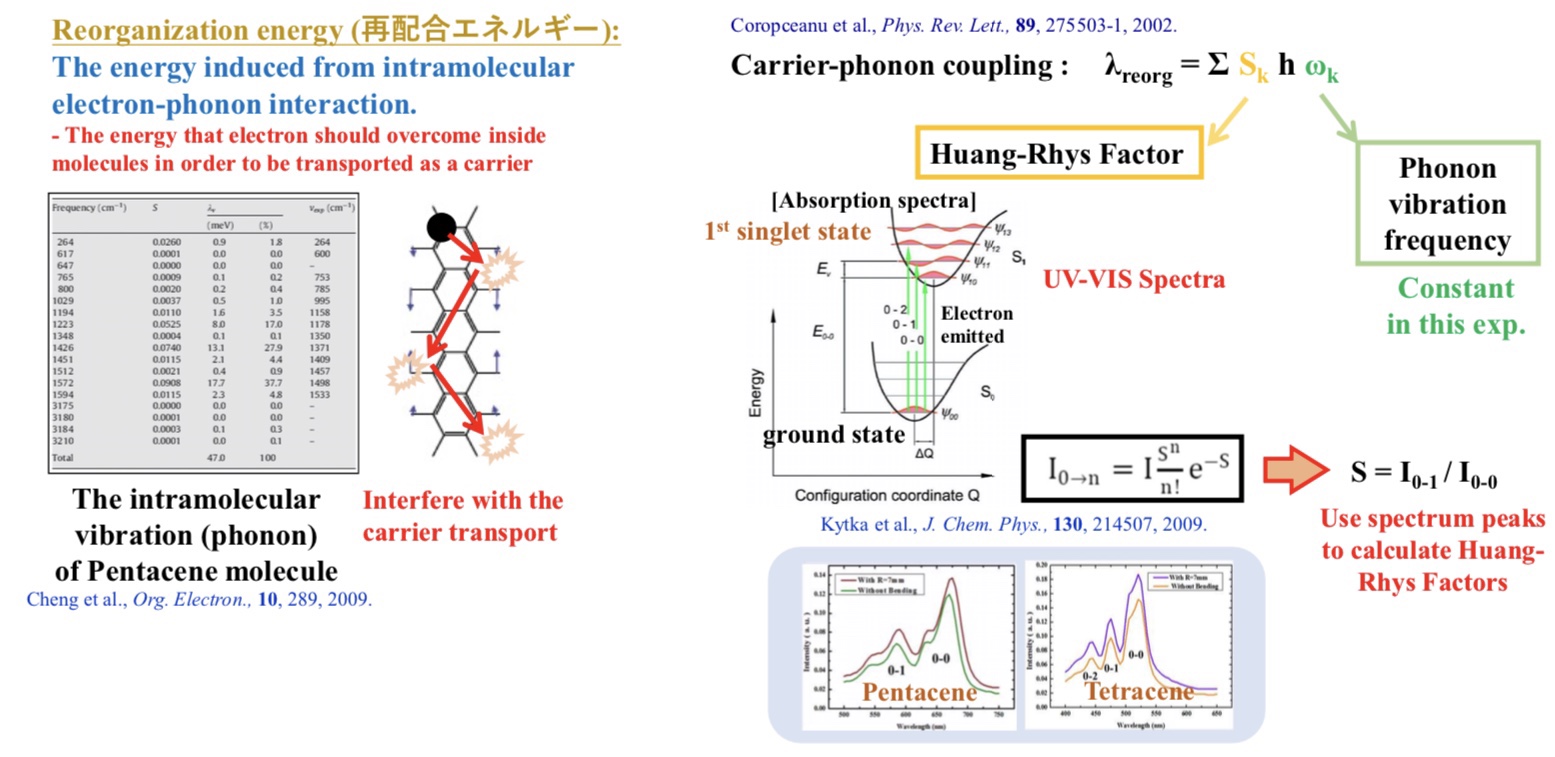
Huang-Rhys Factor 為有機半導體傳輸中之另一機制,也就是Marcus-Hush Equation的另一因子,重組能,重組能之中,Huang-Rhys Factor 會隨著分子間的距離而改變,當兩方分子愈靠近時,此Factor會有所提升,因而造成重組能的向上提升,因而造成分子間Phonon影響加重,大大減低載子在有機半導體內的傳輸效果。Huang-Rhys Factors 的計算上,可以透過紫外光-可見光分析光譜,抑或電激光譜的強弱來計算,在計算過程無法算出絕對的Huang-Rhys Factor,但可計算出其變化量,也就是變化後的計算值,對照變化前的計算值,得到此Factor的變化比例,便可得知這樣的變化影響多少分子間傳輸的能力。
研究的背景知識主要來自以下文獻。
[1] S. Milita, C. Santato, and F. Cicoira, “Structural investigation of thin tetracene films on flexible substrate by synchrotron X-ray diffraction,” Appl. Surf. Sci., vol. 252, pp. 8022-8027, Jun. 2006.
[2] H. L. Cheng, Y. S. Mai, W. Y. Chou, L. R. Chang, and X. W. Liang, “Thickness-dependent structural evolutions and growth models in relation to carrier transport properties in polycrystalline pentacene thin films,” Adv. Funct. Mater., vol. 17, pp. 3639-3649, Feb. 2007.
[3] T. Rada, Q. Chen, and N. V. Richardson, “Scanning tunneling microscopy of tetracene on Si(100)-2 × 1,” J. Phys.: Condens. Matter., vol. 15, no. 38, pp. S2749-S2756, Sep. 2003.
[4] D. A. da Silva Filho, E.-G. Kim, and J.-L. Bredas, “Transport properties in the rubrene crystal: electronic coupling and vibrational reorganization energy,” Adv. Mater., vol. 17, no. 8, pp. 1072-1076, Dec. 2004.

 吉田休日 X 人間探索
發表留言